

The legal framework
Expropriation is the procedure by which the State, a local authority or an empowered body compels an owner to transfer a property or a real right, in whole or in part, to carry out a project in the general interest. The right of ownership is guaranteed by the Constitution (Article 35); it may only be restricted in the cases and forms laid down by law.
The reference text is Law 7-81 on expropriation in the public interest and temporary occupation, promulgated by Dahir 1-81-254 of 6 May 1982 and published in Official Bulletin No. 3685 of 15 June 1983, with its implementing Decree 2-82-382 of 16 April 1983. Two principles govern it:
- No expropriation without a prior declaration of public utility, nor outside the forms laid down by law (Article 1).
- Expropriation is carried out by court order (Article 2): a judge orders the transfer of ownership and sets the compensation, unless an amicable agreement is reached.
The State, local authorities, other public-law entities and persons to whom public authority delegates this right may expropriate (Article 3). Religious buildings, cemeteries, public domain property and military works cannot be expropriated (Article 4).
The steps of the procedure
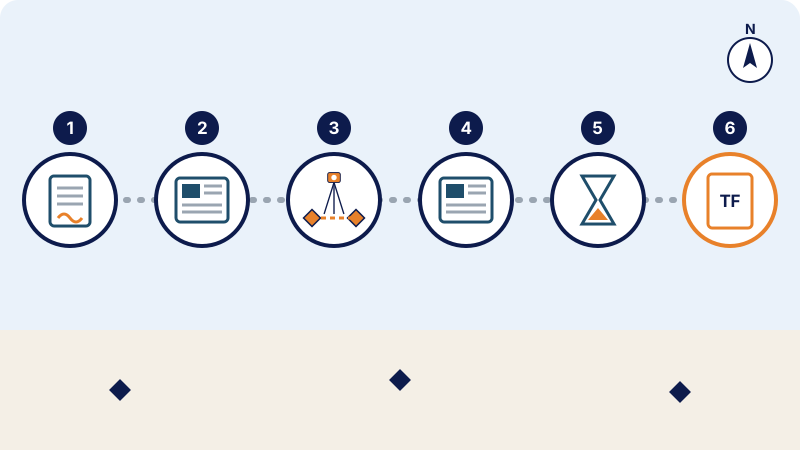
- Declaration of public utility (DUP). Issued by decree on the proposal of the minister concerned (Article 6; Decree, Article 1), it designates the area liable to expropriation. It is published in full in the Official Bulletin, announced in legal-notice newspapers and posted at the municipality (Article 8). If it does not itself designate the properties, the transfer order (acte de cessibilité) must follow within two years of its publication, otherwise a new declaration is required (Article 7).
- Two-month administrative inquiry. The draft transfer order is published in the Official Bulletin and the press, then filed with a plan at the municipality. For two months from publication, anyone may consult it and submit observations (Article 10). The draft is also filed with the land registry, which enters a notice on the titles concerned (Article 12).
- Transfer order. It designates the properties to be expropriated and is published in the same way as the DUP (Article 13). Where the DUP already designates the properties, it serves as the transfer order and the inquiry covers its draft (Article 9).
- Valuation commission and amicable agreement. An administrative commission chaired by the local authority (Decree, Article 7) sets the price offered. The owner may accept it: the amicable agreement is recorded in minutes or a deed and, once filed with the land registry, transfers ownership (Article 42).
- Court phase. Failing agreement, the expropriating authority files two applications with the administrative court: one for transfer of ownership and setting of compensation, the other for taking possession (Article 18). It must do so within two years of the publication of the transfer order, otherwise a new DUP is required (Article 17).
- Payment and transfer of title. Compensation is paid, or deposited if the beneficiaries are unknown or disputed (Articles 29 and 30). Filing the transfer judgment with the land registry clears the property of all rights and charges; third-party rights are carried over to the compensation (Article 37).
Taking possession
The summary-proceedings judge authorises possession against provisional compensation equal to the offers of the expropriating authority (Article 19). He may only refuse it if the procedure is void (Article 24). The authority enters the property only after the order has been served and this compensation paid or deposited (Article 27).
Transfer of ownership and compensation
The expropriation judge orders the transfer and sets the final compensation, necessarily recalling the offers (Article 24). Article 20 sets the rules:
- only actual and certain damage directly caused by the expropriation is compensated;
- value is assessed on the day of the decision ordering the expropriation, disregarding buildings, plantations or improvements made without the authority's consent after the DUP;
- it may not exceed the value of the property on the day the transfer order is published;
- it is adjusted for any increase or decrease in value that the project gives to the remaining part.
The rights of owners
- To be informed and submit observations during the two-month inquiry (Article 10).
- To declare tenants, farmers and other right holders within the same period; otherwise the owner alone remains liable for any compensation they may claim (Article 11). Declared lawful tenants are compensated or rehoused by the expropriating authority (Article 22).
- To require total acquisition of a partly expropriated building, or of land whose remainder becomes unusable, by a declaration made before the end of the inquiry period (Article 23).
- Prior compensation: no possession without payment or deposit of the provisional compensation (Article 27); statutory interest is due if compensation is not paid or deposited within one month (Article 31).
- To challenge: the DUP and the transfer order may be the subject of an action for annulment before the competent administrative court, within the time limits set by Law 58.25 on civil procedure. The transfer judgment can only be appealed as regards the amount of compensation (Article 32), within thirty days of service, before the administrative court of appeal; the possession order cannot be appealed.
- To recover the property: if the authority resells it within five years without having used it for the intended purpose, the former owner may take it back at the compensation price received (Article 40; Decree, Article 5).
Who is involved
- The expropriating authority: the State, a local authority or a delegated body, which conducts the procedure and pays the compensation.
- The local authority and the municipality: filing of the inquiry file, public notice (Decree, Article 3), chairing of the valuation commission.
- The administrative valuation commission: local authority, State property, registration, the authority's representative and, depending on the land, tax, planning or agriculture officers (Decree, Article 7).
- The administrative judge: possession, transfer of ownership, setting of compensation; he may appoint an expert.
- The land registry: notices on titles, certificates, then transfer to the expropriating authority (Articles 12 and 37).
The role of the land surveyor (ingénieur géomètre-topographe). The surveyor is involved from the first plan to the land-record update:
- Parcel plan: the project's footprint drawn over the parcels, based on a survey and land-registry searches.
- Parcel schedule: for each parcel, the land reference (title, réquisition or unregistered land), total and affected areas, presumed owners and occupation.
- Adversarial boundary survey of the footprint and record of the buildings, plantations and equipment affected, used for the valuation.
- Land-record update: division plans and technical files for the transfer of the expropriated part and the title of the remainder.
The surveyor establishes areas and land situations; he does not set the compensation, which is a matter for the commission and, where applicable, the judge.
Documents and plans
- The DUP decree, published in the Official Bulletin.
- The inquiry file: draft transfer order, footprint plan and list of properties, filed at the municipality for two months.
- The parcel plan and schedule, identifying each affected parcel and its area.
- The transfer order, with the list of properties and the annexed plan.
- Land-registry certificates on registered rights (Articles 11 and 12).
- The minutes of amicable agreement, or the possession order and the transfer judgment.
Projects concerned
- Roads, motorways, railways, tramways and road widening.
- Schools, hospitals, sports facilities and urban development operations.
- Dams, water mains, sewers and power lines.
- Ports, industrial and logistics zones declared of public utility.
For studies or works, the administration may also occupy land temporarily, excluding dwellings and adjoining enclosures, against compensation and for five years at most; beyond that, it must expropriate (Articles 50 to 57).
Legal references
- Law 7-81 on expropriation in the public interest and temporary occupation, Dahir 1-81-254 of 6 May 1982, Official Bulletin No. 3685 of 15 June 1983 — consolidated text, Ministry of Justice (French).
- Decree 2-82-382 of 16 April 1983 implementing it, same Official Bulletin.
- Law 58.25 on civil procedure (Official Bulletin No. 7485 of 23 February 2026), which now governs procedure before the administrative courts.
- 2011 Constitution, Article 35; Dahir of 12 August 1913 on land registration (notices on titles).
A revision of Law 7-81 was announced in 2026; at the date of this article, Law 7-81 remains the applicable text.
Frequently asked questions
How long does the inquiry last?
Two months from the publication of the draft transfer order in the Official Bulletin (Article 10). During that period, anyone may consult the file at the municipality and submit observations.
How long does a declaration of public utility remain effective?
If it does not designate the properties, the transfer order must follow within two years of its publication (Article 7). The transfer order itself remains effective for two years: if the court is not seized within that period, a new declaration is required (Article 17).
Can an expropriation be challenged?
Yes. The DUP and the transfer order may be challenged by an action for annulment before the administrative courts. The transfer judgment may be appealed as regards the amount of compensation within thirty days of service (Articles 32 and 33).
Is compensation paid before possession is taken?
Yes. The authority enters the property only after paying or depositing the provisional compensation set by the summary-proceedings judge, equal to its offers (Articles 19 and 27). Any balance follows the final judgment.
What does the summary-proceedings judge do?
He authorises possession against the provisional compensation and may only refuse it if the procedure is void (Article 24). His order cannot be appealed (Article 32).
Are tenants compensated?
Yes, provided they are declared. The owner must name them during the inquiry, otherwise he alone remains liable for their compensation (Article 11); the authority compensates or rehouses declared lawful tenants (Article 22).
Other useful guides
 Parcel plan: knowing who owns what within a project's land takeParcel plan and parcel schedule: identifying the land affected by a project, the areas taken and the land status of each parcel.
 Land registration in Morocco: the steps, from the réquisition to the land titleRéquisition, publication, boundary survey, objections and land title: the steps of land registration in Morocco under the 1913 dahir as amended by Law 14-07.
 Property valuation: how the value of an apartment or a plot of land is estimatedInheritance, sale, partition or loan: how the market value of an apartment or a plot of land is estimated in Morocco, methods and documents.
Written by the surveying engineers of DATUM ENGINEERING, a firm registered on the roll of the ONIGT (National Order of Surveying Engineers).
General information article, based on the standards of the ONIGT (National Order of Surveying Engineers) and the ANCFCC (National Agency for Land Registry, Cadastre and Cartography) and on the texts in force on the date of update. It does not replace an examination of your file.