
When is it needed
- Before earthworks, a trench or drilling.
- Roads and utilities (VRD) project on an existing road.
- Industrial site or facility with incomplete utility plans.
- Updating the utility plans of a site.
Our work
- Collection. Utility operators' and site plans, site visit and opening of accessible manholes.
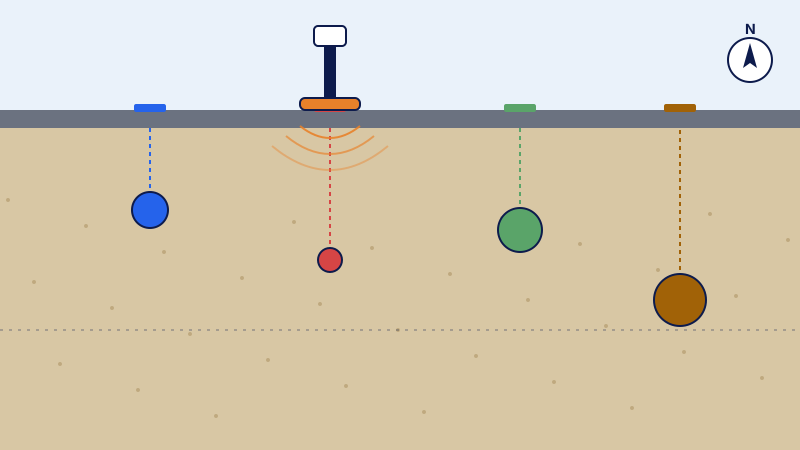
- Detection. Electromagnetic detection for metallic or traceable utilities; ground-penetrating radar (GPR) for non-metallic utilities, depending on the nature of the ground.
- Marking. Utility routes marked on the ground, one colour per utility type.
- Survey. Tied to the Lambert Morocco (Merchich datum) system and to the NGM (Morocco's national levelling datum); cover levels and depths measured where accessible.
- Plan. Utilities by type, with the reliability class of each section.
Detection gives a position subject to an uncertainty that depends on the utility and the ground. Only trial holes or excavation confirm the exact position and depth: the plan states this section by section.
Examples of assignments
- Trench on an existing road
- Extension of an industrial site
- Older subdivision without utility plans
- Drilling or piling area
What you receive
- Plan of detected utilities (DWG, PDF), by type and by colour
- Manhole schedule (cover and invert levels)
- Detection report: methods, limitations, reliability
Reference framework
- Plans of the utility operators and of the client
- ONIGT (National Order of Surveying Engineers) Standard 08 (representation of networks in as-built plans)
- Accuracy standards of the ONIGT
Where we work
The firm is based in Aïn Sebaâ and works in the sixteen districts of Casablanca (Anfa, Maârif, Sidi Belyout, Al Fida, Mers Sultan, Aïn Chock, Hay Hassani, Ben M'Sick, Sbata, Moulay Rachid, Sidi Othmane, Hay Mohammadi, Roches Noires, Aïn Sebaâ, Sidi Bernoussi, Sidi Moumen), in Mohammedia, Bouskoura, Dar Bouazza, Nouaceur, Médiouna, Berrechid, Benslimane, Settat and El Jadida.
Further reading
Frequently asked questions
Can plastic pipes be detected?
Yes, with ground-penetrating radar, with a reliability that depends on the ground: it decreases in clayey or wet soils.
Are trial holes still needed?
Yes, at sensitive points: detection guides the excavation, it does not replace it.